







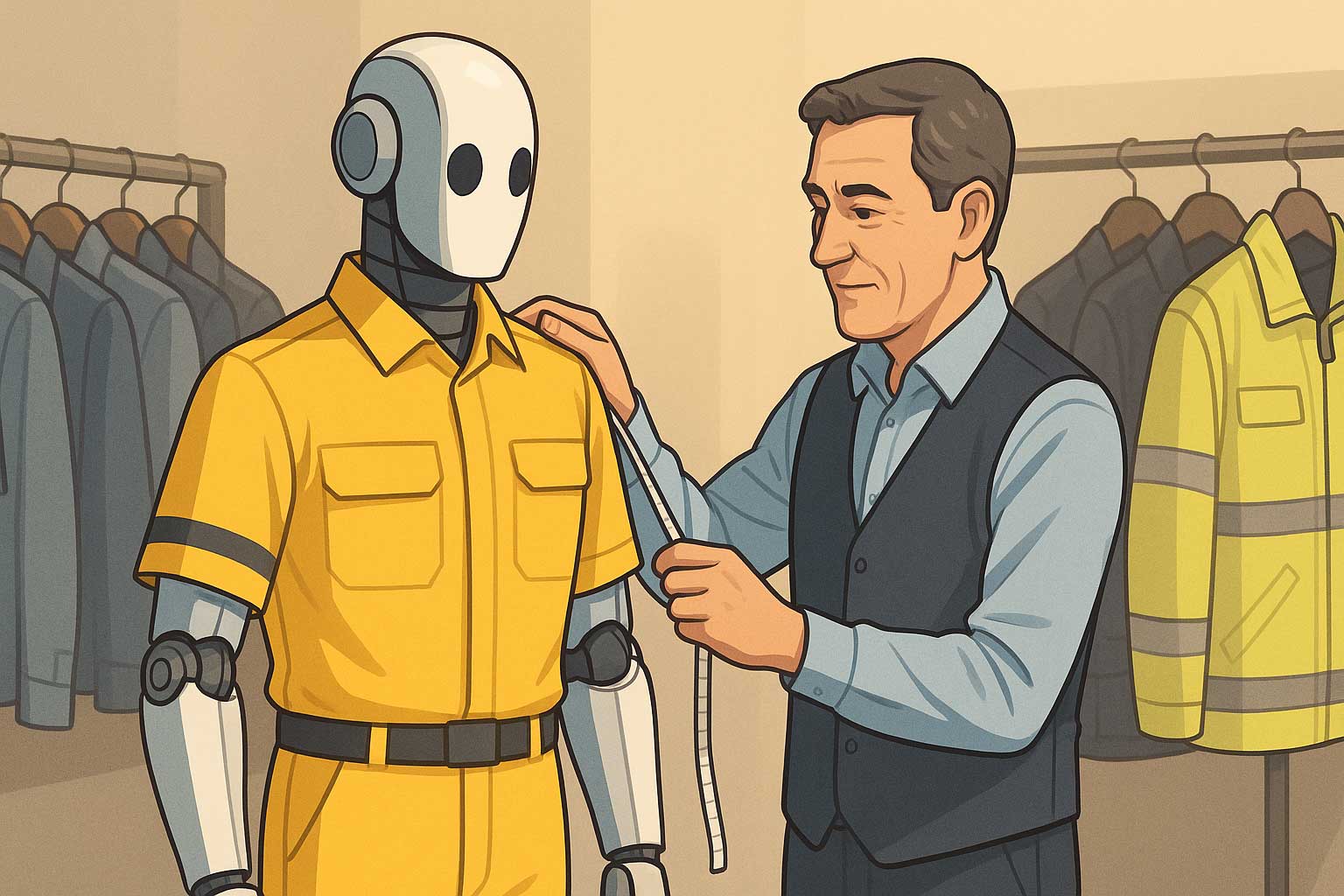

I’ve been known to tease NAUMD members with a running joke: “Give it a decade and you’ll all be fitting uniforms on robots instead of people.” It’s a line I toss out during meetings, partly to get a laugh and partly because jokes are sometimes the safest way to float a stranger idea. Most folks grin politely, a few chuckle, and every now and then someone gives me the kind of slow nod that says, “Wait… should we actually be thinking about that?”
Lately I find myself wondering the same thing. Maybe this little joke of mine isn’t entirely made of hot air. Maybe it’s a small balloon of truth floating toward us from a future where work looks very different, where AI takes on larger pieces of the labor pie, and where our industry has to figure out how to thrive when fewer humans are clocking in wearing polos, pants, and high-vis vests.
This isn’t an obituary for uniforms or for the people who make them. Far from it. But let’s be honest with ourselves: if certain job categories shrink because automation takes over repetitive or dangerous roles, the uniform world could feel the pinch. Fewer warehouse workers means fewer work shirts. Fewer delivery drivers could mean fewer jackets and caps. If police departments use autonomous patrol units for low-risk routes, or if hospitals deploy sanitizing robots instead of overnight cleaning crews, the traditional “wearer count” goes down. That is a real headwind for our industry, and pretending otherwise won’t help us prepare for it.
But here’s where it gets fun—and just a little sci-fi.
Uniforms have never only been about humans. They’ve always been about clarity: safety, identification, compliance, brand presence, and trust. And those needs don’t go away if the person under the garment doesn’t happen to have a pulse.
Imagine a fleet of fire-response units—half humans, half robotic assistants—rolling up to a scene. The humans wear NFPA-rated gear; the robots need heat-resistant shells with unmistakable color patterns and markings so firefighters know exactly who (or what) they’re working beside. Someone has to design and make those exterior housings. Someone has to supply the reflective trims, the protective coatings, the modular add-ons. Someone has to figure out how to badge the thing.
Picture hospital robots delivering meds or shuttling equipment. A patient should not confuse the sanitation bot with the breakfast bot. Hospitals already use color-coding for scrubs; extend that to robotic casings and suddenly you need a full catalog of “soft skins” for different roles.
Or take municipal services. Cities currently debate which shade of blue their parking enforcement officers wear. One day they might argue over what kind of high-visibility wrap best communicates that a patrol drone is official, safe, and not part of a student film project.
These examples may sound playful, but the underlying logic is solid. As machines take on operational roles, the world will still need the same things uniforms have always delivered: function, compliance, clarity, identity. Our industry’s expertise—textile science, durability engineering, sizing systems, visibility standards, customization workflows—doesn’t evaporate. It migrates.
That said, none of this means we should gleefully cheer a future with fewer human workers. Human-centered industries matter. Jobs matter. Community networks matter. If automation reduces headcounts in certain sectors, our industry will lose volume. That’s real. But adaptation has always been the uniform industry’s hidden superpower. We’ve reinvented fabrics, supply chains, trims, fits, sustainability models, and entire product categories over the last century. Reinventing ourselves again—this time for a blended workforce of humans and machines—might be another turn of the wheel.
Maybe we will one day sew covers for robotic arms. Maybe “fit sessions” become “chassis calibrations.” Maybe embroidery machines stitch identification onto flexible sensor-friendly skins instead of shirts. Or maybe humans simply shift into new roles that require new kinds of apparel altogether—roles involving oversight, ethics, inspection, community care, and supervision of these complex automated systems.
Whatever the mix becomes, the industry probably won’t disappear. It will evolve. It always has.
So yes, when I joke about making uniforms for robots, I’m having some fun. But I’m also hinting at a deeper truth: disruption isn’t a binary—here one day, gone the next. It’s a gradient. And somewhere on that gradient is a future where NAUMD members are still designing identity and safety into the world around them… just with some unexpected new clients rolling into their fitting rooms.
If nothing else, it keeps our imaginations limber. And in an era of AI and rapid change, limber might be exactly what we need.