








For a long time, uniform and tactical apparel companies have behaved like supporting characters in their own story. Essential, reliable, but mostly silent. The assumption was simple: the product speaks for itself.
That assumption is starting to crack.
Two recent examples, one playing out on the SHOT Show floor and the other unfolding through a fashion industry retrospective, suggest that something more intentional is happening. Uniform brands are beginning to step forward, not to become louder, but to become more legible.
At SHOT Show 2026, Fechheimer Brothers Company is not treating its Vertx and Flying Cross brands as static product lines. Instead, it is presenting them as part of a living ecosystem.
Yes, there are new launches. Flying Cross is debuting its Prime Flex performance stretch uniform. Vertx is expanding the Gamut Series, marking the tenth anniversary of one of the most influential concealed carry packs ever introduced. But the more interesting move is not what is being launched. It is how it is being framed.
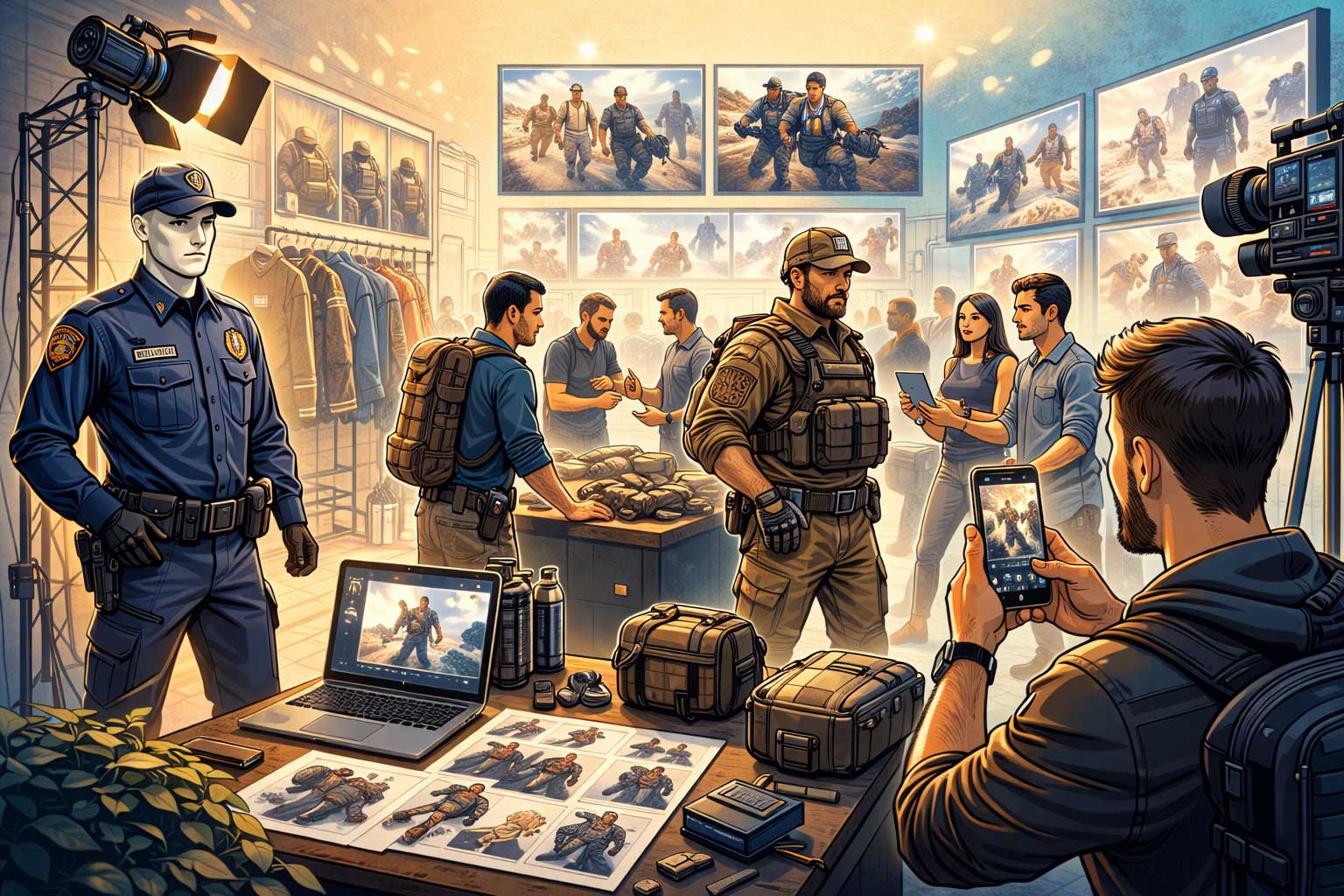
The Vertx and Flying Cross booth is designed less like a showroom and more like a gathering place. Brand ambassadors, competitive shooters, tactical educators, and digital creators are not an afterthought. They are central to the experience. The message is subtle but clear: this gear exists in real lives, real routines, and real communities. It is worn, trusted, debated, and adapted long after the purchase order is signed.
This is a shift from transactional marketing to contextual marketing. The products still matter, but they are presented within the culture that surrounds them.
That makes what is happening with Blauer feel less like an outlier and more like a parallel evolution.
As reported by WWD, Blauer’s 25th anniversary under FGF Industry was marked not by a rush of new product announcements, but by reflection. Archives were revisited. Design history was elevated. The brand positioned itself as both a technical authority in public safety apparel and a design-driven force that has shaped how uniforms communicate authority, protection, and professionalism.
Blauer’s approach leans toward heritage and narrative, drawing in audiences well beyond traditional uniform buyers. Fechheimer’s SHOT Show presence leans toward immediacy and lived experience. On the surface, they could not be more different.
Yet they are responding to the same underlying reality.
Uniforms are not neutral objects. They carry meaning. They shape perception. They sit at the intersection of function, identity, and trust. Pretending otherwise does not make a brand more professional. It makes it invisible.
What is notable in both cases is what these companies are not doing. They are not abandoning performance. They are not diluting technical credibility. They are not chasing fashion or influencers for their own sake. Instead, they are acknowledging that innovation is not only about fabric, patterning, or load distribution. It is also about how a brand understands its role in the broader story of work, safety, and service.
For manufacturers, distributors, and retailers, there is a lesson here that goes beyond marketing tactics.
The next era of uniform branding will reward clarity over caution. Brands that understand what their products represent in the real world, and are willing to frame that story honestly and confidently, will stand apart. Those that continue to whisper while their customers live loudly in their gear may find themselves technically excellent, but culturally absent.
Uniforms have always done more than clothe the job. The companies that recognize that, and design their presence accordingly, are no longer just supplying the industry. They are shaping how it is seen.