








The British Leicestershire Police has announced that female officers will soon be allowed to wear the Blue Light Hijab. This new headscarf was developed in collaboration with De Montfort University Leicester (DMU) and is intended to offer a safer alternative to the traditional hijab.
Hijab with magnets and radio compatibility
The Blue Light Hijab was the idea of Detective Sergeant Yassin Desai, who first conceived the concept twenty years ago. After years of searching for manufacturers and reviewing models implemented internationally, he connected in 2022 with a team at De Montfort University Leicester that was open to developing a unique design specifically for police use.
The fact that it took three years to launch the new hijab is not surprising. Wearing a traditional headscarf as a police officer comes with certain risks. One major concern is that civilians may grab the fabric, potentially placing the officer in a chokehold. There is also a significant chance that the hijab could be pulled off, exposing the woman’s hair. This creates a challenging balance between safety and dignity, while the officer needs to remain focused on her duties.
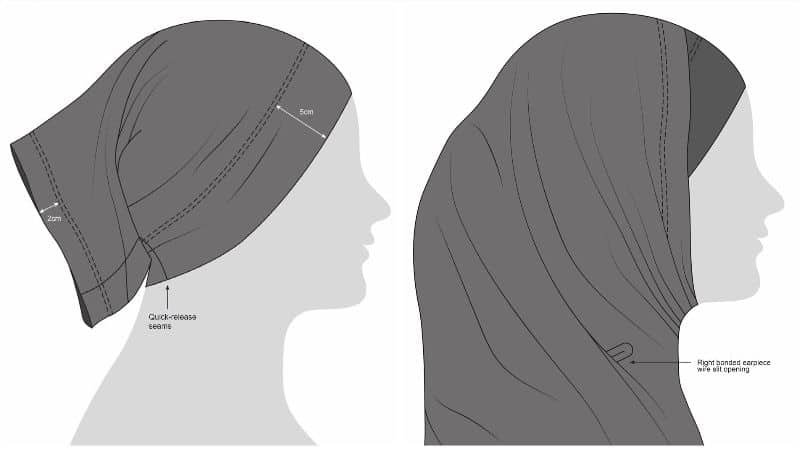
To prevent the hair from becoming visible when the hijab is pulled, the Blue Light Hijab consists of two parts. First, there is a headband with a wide front hem to ensure it stays in place. On top of this, the hijab is worn, which for safety reasons is not fastened with a pin but with a magnet. The scarf closes both under the chin and on the chest. This ensures that if someone pulls the scarf, it will immediately release.
On both the left and right sides, there is a small opening large enough to pass a wire and earpiece through, allowing radio communication to remain unobstructed.
Differences and similarities with New Zealand
Leicestershire Police is not the first law enforcement agency to introduce a specially designed hijab. In 2020, Massey University fashion designer Deb Cumming and fashion lecturer Nina Weaver developed a similar model for the New Zealand Police. Their design also consists of two parts. It includes a base layer connected to a shirt, with a scarf worn over it. This model also features a small opening to accommodate communication devices.
The key difference between the two models is that New Zealand chose to eliminate the traditionally draped fabric around the neck. Additionally, the New Zealand hijab uses both magnets and Velcro for closure. It is made from breathable, antibacterial and moisture-wicking fabric. The British version is made from 95 percent Tencel and 5 percent elastane. While Tencel is known as an environmentally friendly fibre that is soft and breathable, it is not known whether this specific hijab also offers antibacterial or moisture-wicking properties.
Both designs demonstrate how complex it can be to integrate the hijab into a uniform. That complexity varies by industry. In policing, safety concerns are mainly focused on the risk of pulling. In aviation, the headscarf must be worn in a way that allows for the proper use of oxygen masks in emergencies. It is clear that when it comes to uniforms, the development of the hijab is far from complete.
Photo: Blue Light Hijab