








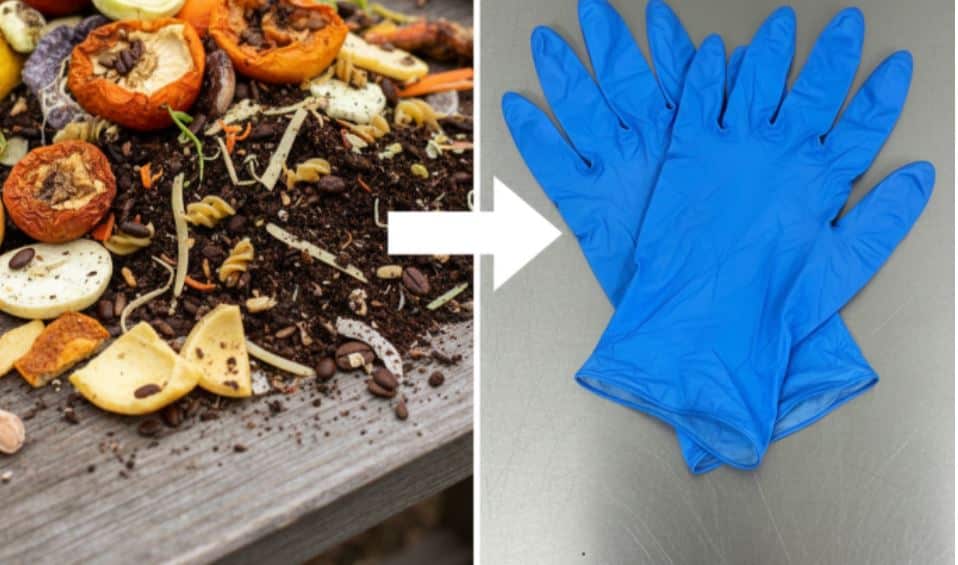

The amount of medical waste produced each year is enormous. This is not only harmful to the environment, but processing this waste is also very expensive. That is why more and more companies are exploring whether sustainable alternatives are possible. In the United Kingdom, researchers are currently investigating whether medical gloves can be made from food waste.
Medical gloves made from food waste
Aston University in Birmingham and manufacturer PFE Medical have joined forces for this project. As unusual as it may sound, researchers state that fruit, dairy products and corn husks contain oxidative and antibacterial properties.
When processed in the right way, these properties could partially replace the materials currently used for medical gloves. This is good news, as food waste is far more environmentally friendly than nitrile, latex or vinyl, which are widely used in glove production today.
Waste as a valuable resource
Although personal protective equipment has not previously been made in this way, using food waste to create new products is not uncommon. The Italian company Orange Fiber, for example, has been using citrus peels to produce textiles for more than ten years. When you consider that the waste left over after citrus juice production accounts for around sixty percent of the fruit’s total weight, it becomes clear how much raw material is available to the company.
That waste can be used to create a wide range of products is also demonstrated by the Netherlands based company Avantium. They combine plant, forest, agricultural and textile waste to develop materials and components for the Danish brewery Carlsberg and bedding specialist Auping. LVMH Perfumes and Cosmetics, known for brands such as Louis Vuitton, Bulgari, Fendi and Givenchy, is also among their clients.
Will waste become the new source for PPE?
It is clear that waste can be a valuable resource for creating new products. However, medical gloves are subject to strict regulations, which makes this development complex. Researchers at Aston University have already indicated that these gloves cannot be used in sterile environments. Surgeons, for example, will still need to rely on the gloves that are currently imported from China, as sterile conditions require a different type of product than these sustainable gloves can provide.
If the researchers succeed in bringing the gloves to market, they will likely be used for low risk tasks. Ultrasound examinations are one such example.
These gloves will therefore not replace all medical gloves, but only a portion of them. Even so, their introduction would represent an important breakthrough in the field of PPE. Despite years of efforts to develop environmentally friendly medical gloves, a truly sustainable alternative has not yet been achieved. In addition to the environmental benefits, this method offers another major advantage: the availability of raw materials. People will always produce food waste. Unlike resources such as oil, this means there is no risk of geopolitical competition between countries that do or do not have access to these materials.
This research clearly shows how challenging sustainability and recycling are within the PPE sector. But as long as innovation continues, we move gradually closer to a circular economy.